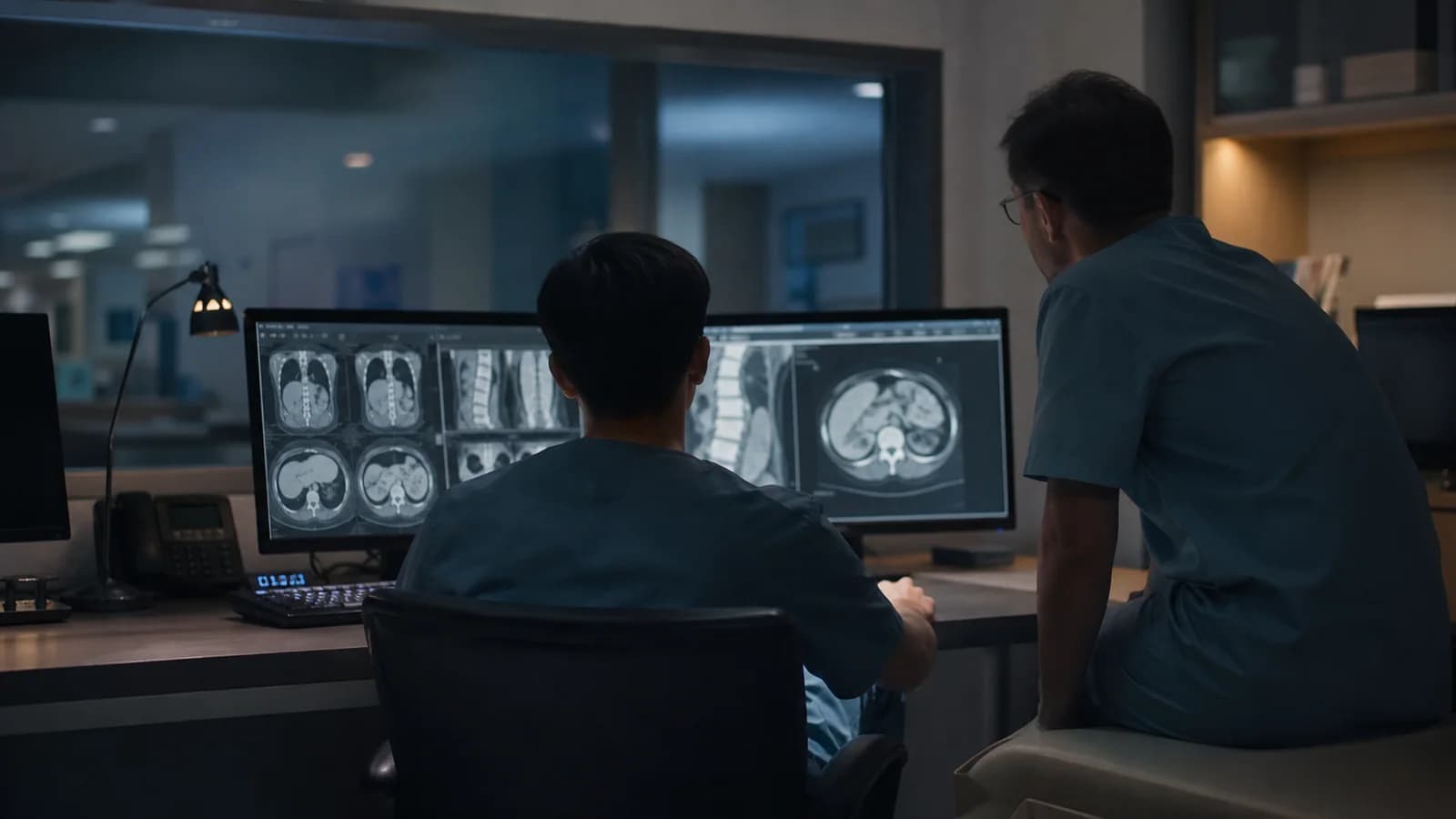
| Quick summary An emergency radiology worklist should not be read only in order of arrival. Safe prioritization considers clinical urgency, time sensitivity, examination adequacy, and who must receive the result. |
|---|
| Medical safety note This content is intended for the education of radiology residents and trainees. It does not provide patient-specific diagnosis, treatment, or emergency management instructions. Institutional protocols, scope-of-practice limits, and the supervising radiologist's guidance take precedence. |
|---|
Why is the worklist not simply first come, first read?
The examinations appearing one after another on the on-call worklist do not all carry the same clinical importance. The result of some studies can change treatment or intervention decisions within minutes. Others influence emergency department flow, but a short delay does not create an immediate patient-safety risk. Prioritization is the process of making this difference visible.
The RCR diagnostic radiology life cycle treats imaging as a single process from referral through delivery of the result. [1] Therefore, reading a study quickly is not enough. Priority also depends on whether the examination is complete, the correct protocol was used, the result reached the right person, and the necessary action was initiated.
Local prioritization rules always take precedence
Hospitals may use different workflows for stroke, major trauma, acute aortic syndromes, pulmonary embolism, postoperative complications, and interventional radiology calls. Use the framework below as a starting point; your institution's written protocol, the supervising radiologist's instructions, and your scope of practice take precedence.
| Before your first shift, learn what the RIS/PACS priority labels mean and who is authorized to change them. |
|---|
A simple four-tier priority model
Without replacing your institution's classification system, you can organize your mental worklist into four tiers:
- Immediate review with simultaneous communication: A delayed result may pose a direct and imminent patient-safety risk. Involve senior support early for this group.
- Time-sensitive examination: A study that will inform a treatment pathway or urgent intervention decision in the near term.
- Examination that determines emergency department or inpatient flow: A study affecting admission, discharge, or consultation, but not meeting the first two tiers.
- Deferrable or scheduled review: A study that should be completed during the shift under local policy but can be sequenced behind higher-priority examinations.
These tiers are not a diagnostic list; they are a workload-management tool. The same type of examination may fall into a different tier depending on the patient's clinical condition.
A 60-second triage for every new study
- What is the clinical question? What is the request actually trying to exclude or demonstrate?
- Is there urgent information about the patient's hemodynamic, neurologic, or respiratory status?
- Is this patient on a time-sensitive clinical pathway?
- Is the examination complete and technically interpretable?
- Who will need to be informed when the result is available?
This brief screen is not a full interpretation of the case. It simply places the study in the correct position on the worklist. When clinical information is insufficient, requesting targeted information from the referring team is safer than making assumptions.
Keep technically incomplete examinations visible
Technical problems such as a missing series, incorrect contrast phase, substantial motion, or anatomy outside the scanned field affect both report quality and worklist priority. Rather than quietly leaving the study for later, clarify a resolution plan with the technologist and clinical team.
- Describe the problem briefly and objectively.
- Within your scope, assess whether additional imaging or a repeat acquisition is needed; consult a senior when necessary.
- Find out when the expected additional series will be available.
- Make the incomplete status visible on the worklist.
- Clearly explain the significance of the delay to the clinical team.
Do not silently try to keep up with simultaneous emergencies
One of the highest-risk moments on call is when several time-sensitive examinations arrive at once. Trying to work faster on your own can create new risks, including missed findings, laterality errors, inadequate communication, and completed drafts waiting unsigned.
- Inform a senior resident or supervising radiologist about the workload early.
- Clarify the true time pressure with the clinical teams.
- When needed, divide reporting and communication tasks within the team.
- When you leave one case for another, mark where you stopped.
- Track unsigned drafts and already communicated critical results separately.
| Reporting that the worklist has exceeded safe capacity is a patient-safety intervention, not a performance problem. |
|---|
Do not rely on the RIS priority label alone
Electronic priority labels are useful, but they may be entered with incorrect or incomplete clinical information. Not every study labeled urgent is equally time-sensitive, and an examination labeled routine may contain an unexpected critical finding. Priority may need to be reassessed after the images are opened.
RCR reporting standards aim for reports to be actionable communications that answer the clinical question and prompt appropriate care. [2] This approach also requires prioritization decisions to be considered in terms of their ultimate clinical effect.
When priority changes, change the communication
If you identify a time-sensitive finding while reviewing a study, you may need to start the local critical notification process before completing the report. ACR and RCR guidance emphasizes that urgent or unexpected significant findings should not be left only in the report; they should be communicated promptly and in a way that can be documented. [3,4]
- Identify the clinician currently responsible for the patient.
- Communicate the finding and its urgency in one clear, concise sentence.
- Confirm that the recipient has received the message.
- Document the date, time, method, and recipient.
- If the responsible person cannot be reached, follow the local escalation or fail-safe pathway.
Use a return marker to manage interruptions
You may have to interrupt an examination because of a phone call, a technologist's question, or a new emergency case. When you return, restarting the systematic review from the beginning is the safest approach. You can also mark the series and system where you stopped in the report draft or a personal work note, without including patient information.
Grouping workflow wording such as "technical limitation," "additional series pending," "preliminary report," and "critical communication" separately in RadPhrases can help prevent an incomplete report after an interruption. Automated text must not make prioritization decisions or replace clinical judgment. [5]
A recurring mini-check throughout the shift
☐ Is there a new time-sensitive examination on the worklist?
☐ Is there an incomplete examination or one awaiting additional series?
☐ Is there a case with a communicated critical finding but an incomplete report?
☐ Is there a result for which the responsible clinician could not be reached?
☐ Is there a case awaiting senior review?
☐ Is there an open task that must be communicated at handover?
References
- Royal College of Radiologists - The diagnostic radiology life cycle guidance. Source (opens in a new tab)
- Royal College of Radiologists - Standards for interpretation and reporting of imaging investigations, third edition. Source (opens in a new tab)
- American College of Radiology - Practice Parameter for Communication of Diagnostic Imaging Findings. Source (opens in a new tab)
- Royal College of Radiologists - Recommendations on alerts and notification of imaging reports. Source (opens in a new tab)