
How to Create a Standard Radiology Report Template: A Step-by-Step Guide
Create a standard radiology report template that focuses on the clinical question, is easy to edit, and helps reduce reporting errors.
RadPhrases Editorial Team8 min de lectura
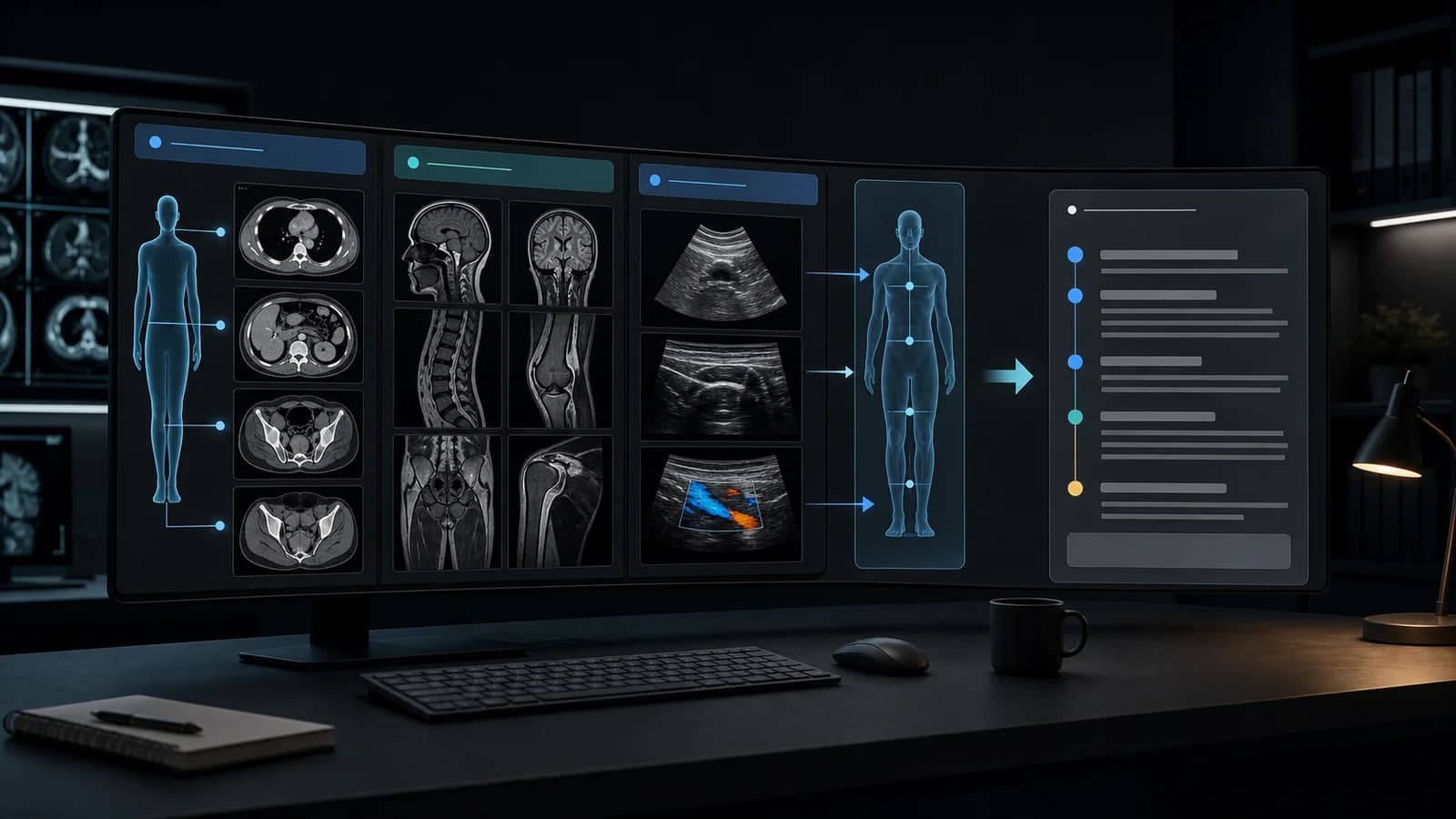
Create a standard radiology report template that focuses on the clinical question, is easy to edit, and helps reduce reporting errors.
A good radiology report template does more than save typing time. It supports systematic image review, helps reduce omission of important areas, and allows the clinical message to be presented more consistently across reports.
A poorly designed template can do the opposite. It may make the report unnecessarily long, create errors through default normal statements, and hide important findings within excessive text.
The steps below show how to build a template that works in daily practice.
The intended use should be defined before any template is created.
Answer the following questions:
A broad label such as “abdominal CT” may be too general for a single template. The following variants have different requirements:
The more clearly the template’s scope is defined, the fewer unnecessary fields and incorrect assumptions it will contain.
A template should not simply list organs. It should be designed to answer the common clinical questions associated with the examination.
For example, the primary clinical question in a CT pulmonary angiography template is acute pulmonary embolism. The following elements should therefore be prominent:
Including every detail from a routine chest CT template at the same level of prominence may distract from the emergency question.
The following sections provide a sufficient starting point for most templates:
Includes the clinical question and relevant concise information. The referral text may need to be meaningfully summarized rather than copied automatically.
Describes the protocol, contrast administration, and important limitations affecting diagnostic assessment.
The date and type of prior examination should be stated clearly whenever possible. “Compared with prior imaging” may be insufficient on its own.
Uses a systematic sequence appropriate for the examination.
Synthesizes the important diagnostic messages in order of priority.
Additional fields may be included according to institutional requirements, but every field should add real value to the report.
A template works more effectively as a checklist when it follows the way the examination is actually reviewed.
For example, a possible sequence for a complete abdominal ultrasound is:
The sequence may vary by department and practice. What matters is that the template and the real image-review workflow support each other.
Not every field should have the same status.
Core elements that must be reviewed in every examination.
Sections that should appear only when a specific finding or clinical situation is present.
Examples:
Details that can be added according to examination coverage or clinical relevance.
Keeping conditional fields visible in every default report makes the template unnecessarily long and increases the risk that they will be completed incorrectly.
Templates can be designed using three basic approaches.
The headings are present, and the user completes every field.
Advantage: Lower risk of leaving an incorrect normal statement in the report. Limitation: May require more typing.
The template opens with normal statements, which the user edits according to the pathology.
Advantage: Fast for normal examinations. Limitation: Unedited false-negative statements can become a serious source of error.
The user actively chooses a normal, negative, or positive variant.
Advantage: Encourages deliberate insertion of each sentence. Limitation: May require excessive clicking if the interface is poorly designed.
One of the safer practices with text-expansion tools is to actively call short phrases as needed instead of automatically inserting a long normal report.
Template sentences should be easy to adapt to the individual case.
Difficult-to-edit sentence:
Both kidneys are normal in location and size, with normal parenchymal thickness, echogenicity, and central sinus structures, and no dilatation of the pelvicalyceal systems or echogenic focus compatible with a calculus is identified within their lumina.
More editable approach:
The kidneys are normal in size and location. Parenchymal thickness and echogenicity are normal. No pelvicalyceal dilatation or calculus is identified.
In the second example, changing only the pathological component is easier. Short sentences also make speech-recognition and text-expansion errors easier to detect.
Variable fields such as measurements, laterality, dates, and categories should be clearly visible.
Weak placeholder:
The lesion measures ... mm.
More visible placeholder:
[SIZE: __ × __ mm]
Alternatively, use a mandatory field when the reporting system supports it.
Placeholders should be easy to search for before report finalization. Ellipses or ambiguous characters may remain unnoticed in the final report.
Common variables that require checking include:
Listing every possible negative finding does not automatically make a report safer. The value of a negative statement comes from answering the clinical question.
For example, the following negative findings may be relevant in an assessment for acute aortic syndrome:
Numerous clinically irrelevant normal anatomical details do not need to be transferred into the impression.
The impression should not be an automatic copy of the findings. A useful template framework may include:
Example:
1. Acute thromboembolism in segmental pulmonary arterial branches of the right lower lobe. 2. Increased right-to-left ventricular ratio; clinical and echocardiographic assessment for right heart strain may be considered. 3. Small peripheral wedge-shaped opacity in the right lower lobe, possibly representing pulmonary infarction.
This structure makes the main message visible in the first line.
A template should define which text is added and which text must be deleted in specific circumstances.
Example rules:
These rules should be visible in user training and template documentation.
Before deployment, the template should be tested on a normal examination and across other relevant scenarios:
During each test, ask:
Report templates should not be created once and then forgotten. Classification systems, follow-up recommendations, institutional protocols, and technical practices can change.
The following information is useful for each template:
Templates that automatically generate categories or follow-up recommendations require regular clinical content review in particular.
The framework below is not clinical content intended for direct use in a specific examination. It illustrates template-design logic.
INDICATION: [Clinical question]

TECHNIQUE: [Modality, protocol, contrast, important limitation]

COMPARISON: [Date and examination type / No prior examination]

FINDINGS: [Examination-specific systematic sequence]

IMPRESSION:

1. [Primary diagnostic message]
2. [Additional management-changing finding]
3. [Specific and justified recommendation, if needed]
A good radiology report template is not the template with the greatest number of sentences. The best template keeps the clinical question visible, reminds the user of key assessment areas, can be rapidly adapted to the case, and reduces the risk of leaving incorrect default text in the final report.
A template should be designed as a framework for thinking and communication, not as an automatic report generator. The radiologist’s core value lies not in filling fields, but in prioritizing findings correctly and translating them into a meaningful clinical conclusion.
Este contenido es educativo y no constituye asesoramiento médico específico para un paciente. Antes de firmar, el médico debe verificar y adaptar cada frase, plantilla, resultado de clasificación y recomendación teniendo en cuenta todas las imágenes, el contexto clínico, las guías vigentes y el protocolo del centro.
Add curated phrases and editable templates to your workflow to support a clearer shared reporting language.
Explora otras listas de comprobación, expresiones y métodos sistemáticos de este tema.