
10 Common Radiology Report Template Errors and How to Prevent Them
Learn how to prevent common radiology report template errors, including false normal statements, contradictions, laterality mistakes, and measurement errors.
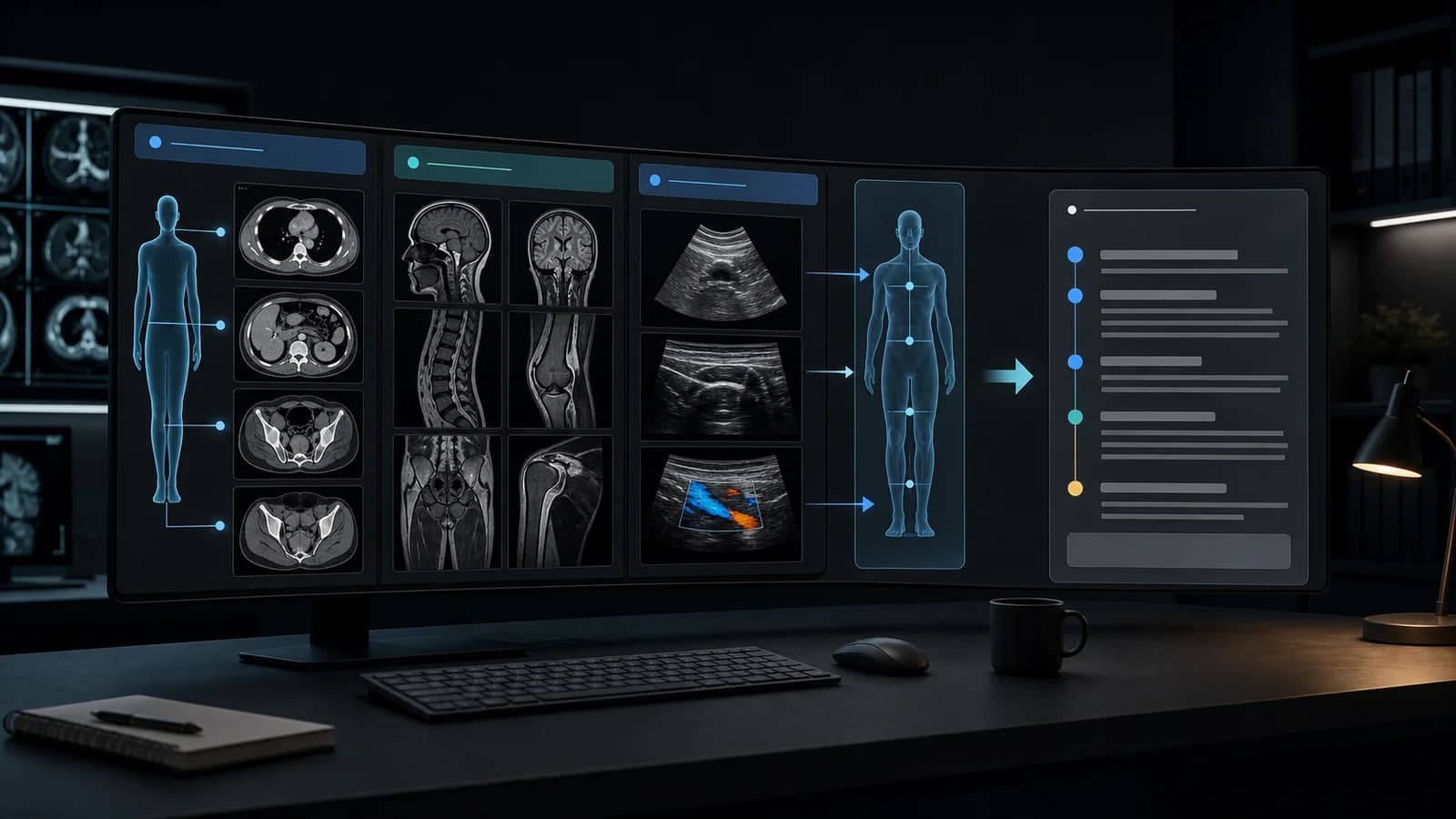
Report templates can improve speed and consistency in daily radiology practice. In frequently performed examinations, they can reinforce a systematic review sequence, reduce repeated typing of normal statements, and help present conclusions in a shared format.
The existence of a template does not mean the report is correct. The most dangerous template-related mistakes are often not dramatic typographical errors. They are small inconsistencies that are approved unnoticed because the text looks professional and complete.
Below are ten common errors in radiology report templates and practical checks that can help reduce them.
1. Leaving an unevaluated structure described as “normal”
This is the fundamental risk of default-normal reports. A structure that cannot be adequately assessed because of technical limitations, incomplete coverage, patient motion, or anatomical variation may remain described as normal in the template.
Incorrect example
The pancreas is normal in size and parenchymal appearance.
In reality, the pancreas may not have been adequately evaluated on ultrasound because of extensive bowel gas.
Better approach
The pancreas could not be adequately evaluated because of extensive bowel gas.
Prevention
- Consider starting the template with headings rather than normal text.
- Create a prepared “not adequately assessed” variant for structures that are frequently limited technically.
- Before finalizing the report, ask “Did I actually see this structure?” for every normal statement.
2. Leaving positive and negative statements in the same report
A direct contradiction occurs when a positive finding is added without deleting the template’s negative statement.
Incorrect example
No pleural effusion is present. A moderate right pleural effusion is present.
This error reduces the reader’s confidence in the report and may create risk for clinical decision-making.
Prevention
- Design shortcuts that insert a positive statement to replace the related negative statement automatically. When the system does not support this, create a manual deletion rule.
- At the end of the report, cross-check words such as “no,” “absent,” and “not identified” against the positive findings.
- Perform the same consistency check between the findings and impression.
3. Retaining incorrect technique text
Contrast status, acquisition phase, protocol, or reconstruction information may remain from another template.
Incorrect example
Arterial and portal venous phase images were obtained following intravenous contrast administration.
The examination may actually have been performed without contrast.
Prevention
- Use separate template variants for contrast-enhanced and noncontrast examinations.
- Verify the technique section at the beginning of the reporting process.
- Search for protocol terms such as “contrast,” “arterial,” “venous,” and “delayed” during the final review.
4. Making a laterality error
Right-left errors can easily arise during speech recognition, copying, or editing of a previous report.
Incorrect example
In the findings:
A 12 mm calculus is present in the lower pole of the left kidney.
In the impression:
Right lower-pole renal calculus.
Prevention
- Reverify every finding that includes laterality instead of automatically copying it into the impression.
- Search separately for the words “right” and “left” before finalization.
- Consider numbering or tabulating multiple lesions.
- Make laterality a visible mandatory placeholder field.
5. Making measurement and unit errors
Confusing millimeters with centimeters, transferring an incorrect previous measurement, or listing three dimensions in a different order can alter clinical interpretation.
Incorrect example
The lesion measures 18 cm.
The actual measurement on the image may be 18 mm.
Prevention
- Establish a preferred basic unit within the department.
- Do not automatically assume the unit when transferring a measurement from the image to the report.
- When comparing examinations, evaluate current and prior measurements using the same plane and method.
- If a measurement is repeated in the impression, verify consistency between the two sections.
6. Carrying text forward from a previous case
Copy-forward or editing a previous report may be fast, but pathology, dates, technical details, or recommendations from another patient may remain in the new report.
Typical remnants
- Prior surgical history
- Old lesion measurement
- Incorrect comparison date
- Laterality from the previous patient
- A follow-up recommendation that is no longer applicable
Prevention
- When possible, start with a clean master template rather than a patient report.
- Transfer only the necessary information from the prior report.
- Search dates, measurements, and proper-name fields during the final check.
7. Leaving placeholders in the final report
Ellipses, “[measurement],” “XX mm,” or unselected fields may remain in the finalized report.
Incorrect example
A ... × ... mm lesion is present in the right hepatic lobe.
This is not merely a formatting issue. It indicates that the report is incomplete and the measurement is uncertain.
Prevention
- Use unique, searchable placeholders rather than ordinary ellipses, such as
[ENTER_SIZE]. - Use mandatory fields when supported by the reporting system.
- Before finalization, search for
[,],XX,__, and....
8. Turning the impression into a copy of the findings
A template may automatically transfer every positive finding into the impression. Without clinical prioritization, this creates a long repetition.
Weak impression
There is a liver cyst. There are gallstones. There is a renal cyst. The prostate is enlarged. There is aortic atherosclerosis.
More useful approach
1. Cholelithiasis without imaging findings of acute cholecystitis. 2. No acute abdominal abnormality. 3. If clinically indicated, prostate volume and lower urinary tract symptoms may be correlated with urologic assessment.
The impression should reflect clinical significance and priority rather than listing every incidental finding with equal weight.
Prevention
- Rewrite the impression actively at the end of the reporting process.
- Place the primary diagnosis or answer to the clinical question first.
- Remove low-priority findings that do not change management, or group them appropriately.
9. Using an outdated classification or recommendation
Systems such as TI-RADS, PI-RADS, BI-RADS, O-RADS, and Bosniak may be revised over time. A category definition or follow-up recommendation retained in an old template may no longer align with current practice.
Prevention
- Record the name and version of the source guideline for every template.
- Have content that generates automatic recommendations reviewed periodically by a specialist editor.
- Allow the user to see the inputs used to generate the category.
- Retire old templates when an update is made rather than simply adding a new copy.
Institutional protocols and current official sources should take priority for this type of content.
10. Forcing a case into a template that does not fit
Complex postoperative anatomy, extensive trauma, multisystem malignancy, or rare disease may not fit meaningfully into the sections of a routine template.
Distributing related findings across separate headings simply to preserve the template can fragment the diagnostic story.
Prevention
- Do not view abandoning the template as failure.
- Preserve the basic top-level structure but convert the findings section into problem-oriented free text.
- Explain clinical relationships in a single paragraph or numbered problem list.
- Spend more time on the impression in complex cases.
A workflow that reduces template-related errors
A brief three-stage check can be performed before report finalization.
1. Technique and identity check
- Correct patient and correct examination
- Correct protocol and contrast information
- Correct comparison date
2. Internal-consistency check
- Right-left consistency
- Positive-negative contradictions
- Findings-impression consistency
- Measurement and unit consistency
- Residual placeholders
3. Clinical-message check
- Clear answer to the clinical question
- Visibility of the most important finding
- Urgency and communication documentation when required
- Specific and justified recommendation
This check should be brief enough to perform in seconds, but repeated in the same sequence for every report.
Additional considerations for text-expansion tools
Adding sentences through shortcuts can reduce manual typing, but selecting the wrong shortcut or confusing similar codes can create new types of errors.
For safer use:
- Watch and read the expanded text as it appears on the screen.
- Distinguish shortcuts that look similar but have different clinical meanings.
- Reverify selections in shortcuts that include severity or laterality.
- Prefer smaller, editable components over a single long shortcut that contains multiple assumptions.
- Delete outdated phrases from your personal library.
Predictable systems such as the RadPhrases shortcut grammar may make learning easier, but responsibility for the clinical accuracy of inserted text always remains with the user.
A 20-second pre-finalization checklist
- The technique text matches the examination performed.
- A structure that could not be evaluated is not described as normal.
- Right and left references are consistent.
- Measurements and units are correct.
- Positive and negative statements do not contradict each other.
- No placeholders remain.
- No text remains from a previous patient or old report.
- The findings and impression communicate the same clinical message.
- The impression presents the most important finding first.
- Recommendations are current, justified, and appropriate for the case.
In daily practice
The greatest advantage of report templates is their ability to organize repetitive work. Their greatest risk is the false sense that a report is complete. No matter how well a template is designed, every sentence must be reverified against the images and clinical information.
Safe template use requires accurate content, active editing, and a consistent final review. The goal is not to produce more text. It is to communicate more accurate and understandable clinical information with less unnecessary variation.
References
- Hartung MP, Bickle IC, Gaillard F, Kanne JP. How to Create a Great Radiology Report (opens in a new tab). RadioGraphics. 2020.
- Radiological Society of North America. RadReport reporting templates (opens in a new tab).
- Larson DB, et al. Strategies for Implementing a Standardized Structured Radiology Reporting Program (opens in a new tab). RadioGraphics. 2018.
- American College of Radiology. ACR Practice Parameter for Communication of Diagnostic Imaging Findings (opens in a new tab). Revised 2025.
Clinical use note
This content is educational and is not patient-specific medical advice. Every phrase, template, classification result, and recommendation must be verified and adapted by a physician using the complete examination, clinical context, current guidelines, and institutional protocol.
Make your reporting language more consistent
Add curated phrases and editable templates to your workflow to support a clearer shared reporting language.
Related calculators
Browse the other checklists, phrase sets, and systematic approaches in this topic.