
Lung-RADS v2022: Nodule Categories, Growth, and Reporting Guide
Learn how Lung-RADS v2022 handles solid, part-solid, and ground-glass nodules, growth, categories 4A–4X, and practical reporting.
RadPhrases Editorial Team8 min de lectura
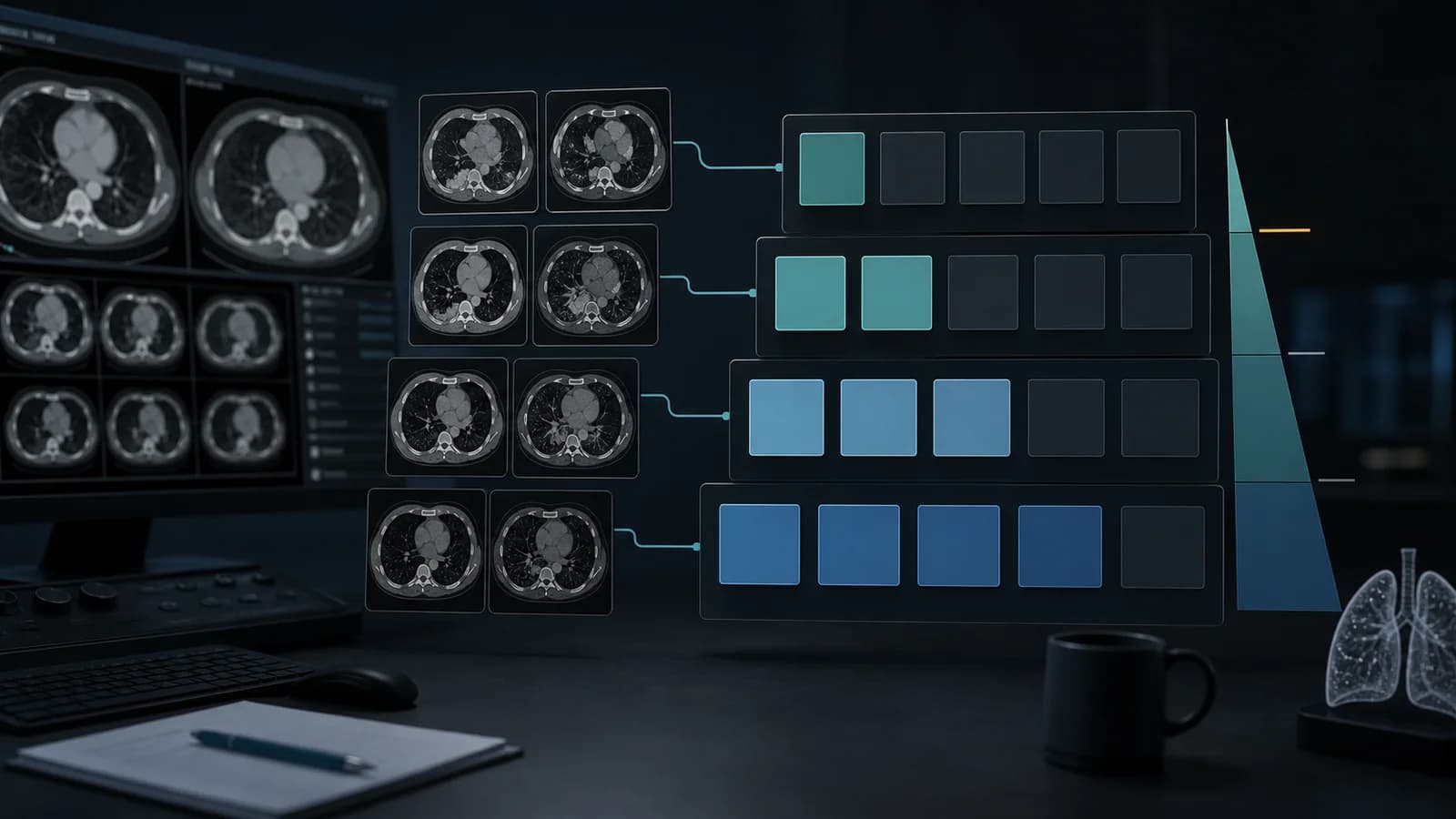
Learn how Lung-RADS v2022 handles solid, part-solid, and ground-glass nodules, growth, categories 4A–4X, and practical reporting.
Lung-RADS v2022 assigns a screening examination category from its most suspicious eligible finding and links that category to a management pathway. It is intended for low-dose CT performed within a lung cancer screening program; do not automatically apply it to diagnostic chest CT in symptomatic patients or to incidentally detected nodules.
This article does not replace the official ACR Lung-RADS v2022 table. Every screening program should operate according to current national eligibility criteria and multidisciplinary protocols.
| Category | General meaning | Typical next step |
|---|---|---|
| 0 | Incomplete or temporary assessment | Comparison with prior CT or short-interval reassessment |
| 1 | Negative | Screening LDCT in 12 months |
| 2 | Benign appearance or indolent behavior | Screening LDCT in 12 months |
| 3 | Probably benign | LDCT in 6 months |
| 4A | Suspicious | Usually LDCT in 3 months; PET/CT in selected cases |
| 4B | Very suspicious | Diagnostic CT, PET/CT, tissue sampling, or clinical evaluation |
| 4X | Category 3 or 4 nodule with additional suspicious features | Further evaluation according to the category and additional finding |
| S | Significant finding unrelated to lung cancer | Management appropriate to the finding |
The examination category is determined by the most suspicious nodule. Even when an examination is classified as negative, other nodules that do not alter the category may still be present.
Lung-RADS should be used only when the examination is part of a lung cancer screening program. A history of cancer, new hemoptysis, or unexplained weight loss may shift the examination into a diagnostic context. In such a setting, mechanically applying a screening table may fail to answer the clinical question.
Place the nodule into one of the following groups:
Incorrectly selecting the nodule type changes the category thresholds entirely. In a part-solid nodule, measure and report the total diameter and the diameter of the solid component separately.
In v2022, mean diameter may be reported to the nearest tenth of a millimeter as the average of the long- and short-axis measurements. When available, volume may also be reported and rounded to the nearest whole cubic millimeter.
For comparison, use the same window, similar section thickness, and a consistent measurement method. Thin-section reconstructions are particularly important when assessing the solid component of a part-solid nodule.
Lung-RADS v2022 defines growth as an increase in mean diameter of more than 1.5 mm within a 12-month interval. However, solid or part-solid nodules that grow more slowly but continuously over serial examinations may still be suspicious. They should not be considered benign merely because they do not meet the single-year threshold.
Thresholds for a new nodule are not the same as those used for a nodule at baseline. A newly developed smaller nodule may enter a higher category.
The main thresholds in the official v2022 table can be summarized as follows:
Lower diameter thresholds apply to new or growing nodules. The report should therefore state not only the current size, but also whether the nodule is new or growing.
In a part-solid nodule, the solid component has a major effect on malignancy risk in addition to the total diameter. At baseline, a nodule with a total diameter of 6 mm or more and a solid component smaller than 6 mm often enters the category 3 branch. A solid component measuring 6 to <8 mm raises consideration of category 4A; 8 mm or more raises consideration of category 4B.
Writing only “12 mm part-solid nodule” is insufficient. Record both measurements—for example, “total diameter 12 mm, solid component 5 mm.”
Ground-glass nodules may follow a more indolent course. Under v2022, many non-solid nodules smaller than 30 mm remain category 2, whereas new or baseline nodules measuring 30 mm or more may enter category 3. A slowly enlarging non-solid nodule is managed according to the system's specific notes as long as no solid component develops.
The development of a new solid component during follow-up may be more important than an increase in total diameter.
Small, smooth, oval, lentiform, or triangular nodules adjacent to the pleura and showing the typical appearance of a benign intrapulmonary lymph node may be category 2.
Segmental or more proximal airway nodules may be assigned category 4A at baseline. If a proximal airway nodule persists at 3-month follow-up, it may be upgraded to 4B, prompting consideration of additional evaluation such as bronchoscopy.
A major v2022 update is a more detailed approach to atypical pulmonary cysts. Thin-walled, regular cysts are generally not managed within Lung-RADS. Thick walls, asymmetric wall thickening, a mural nodule, multiloculation, or serial growth increase suspicion.
In a cavitary nodule, use the atypical-cyst approach when wall thickness is the dominant feature; use the solid-nodule approach when a nodular component is dominant.
Category 4X is used when a category 3 or 4 nodule has additional imaging features that increase suspicion for malignancy. Examples include:
4X is not an “X modifier”; it is a separate Lung-RADS category. It should not be confused with the S modifier.
S may be added to categories 0–4 for a clinically significant or potentially significant finding not directly related to lung cancer. It may not be necessary for a stable finding that is already known and under evaluation. Coronary calcification, an aortic aneurysm, or another important finding should be reported according to the local protocol.
Findings: A solid nodule with a mean diameter of 7.2 mm in the right upper lobe on the initial screening LDCT.
Report example:
There is a solid pulmonary nodule in the right upper lobe with a mean diameter of 7.2 mm. The finding is consistent with Lung-RADS v2022 category 3. Follow-up with low-dose chest CT in 6 months is recommended.
Findings: A baseline part-solid nodule in the left upper lobe with a total diameter of 14 mm and a 7 mm solid component.
Report example:
In the left upper lobe, there is a part-solid nodule with a total mean diameter of 14 mm and a solid-component mean diameter of 7 mm. Lung-RADS v2022 category 4A. Low-dose chest CT in 3 months is recommended; PET/CT may be considered according to the size of the solid component and clinical risk.
A different guideline may be appropriate for an incidental nodule or a symptomatic patient.
New nodules may receive a higher category at a smaller diameter.
The solid component must be measured separately.
Measure consistently using the average of the long and short axes.
Nodule type, growth, and additional suspicious features may be more important than size alone.
An indeterminate inflammatory or infectious appearance may be assessed as Lung-RADS 0 with LDCT in 1–3 months in selected cases. A more malignant-appearing focus should receive the appropriate category.
No. It is a suspicious-finding category and usually requires short-interval follow-up. PET/CT or additional evaluation may be added according to the clinical context.
No. Lung-RADS is used for nodules detected within a screening program; Fleischner recommendations are generally used for incidentally detected nodules.
Although it does not meet the official growth threshold, continuous enlargement across multiple examinations may still be suspicious. Serial behavior should be assessed clinically, especially for solid or part-solid nodules.
Este contenido es educativo y no constituye asesoramiento médico específico para un paciente. Antes de firmar, el médico debe verificar y adaptar cada frase, plantilla, resultado de clasificación y recomendación teniendo en cuenta todas las imágenes, el contexto clínico, las guías vigentes y el protocolo del centro.
Use the relevant RadPhrases calculator, then verify the result against the official guideline and the complete examination.
Aplica de forma interactiva los pasos de clasificación o medición de esta guía.