Upper, Lower, and Complete Abdominal Ultrasound: Scope and Preparation
Compare upper, lower, and complete abdominal ultrasound, including preparation, target organs, and technical limitations.
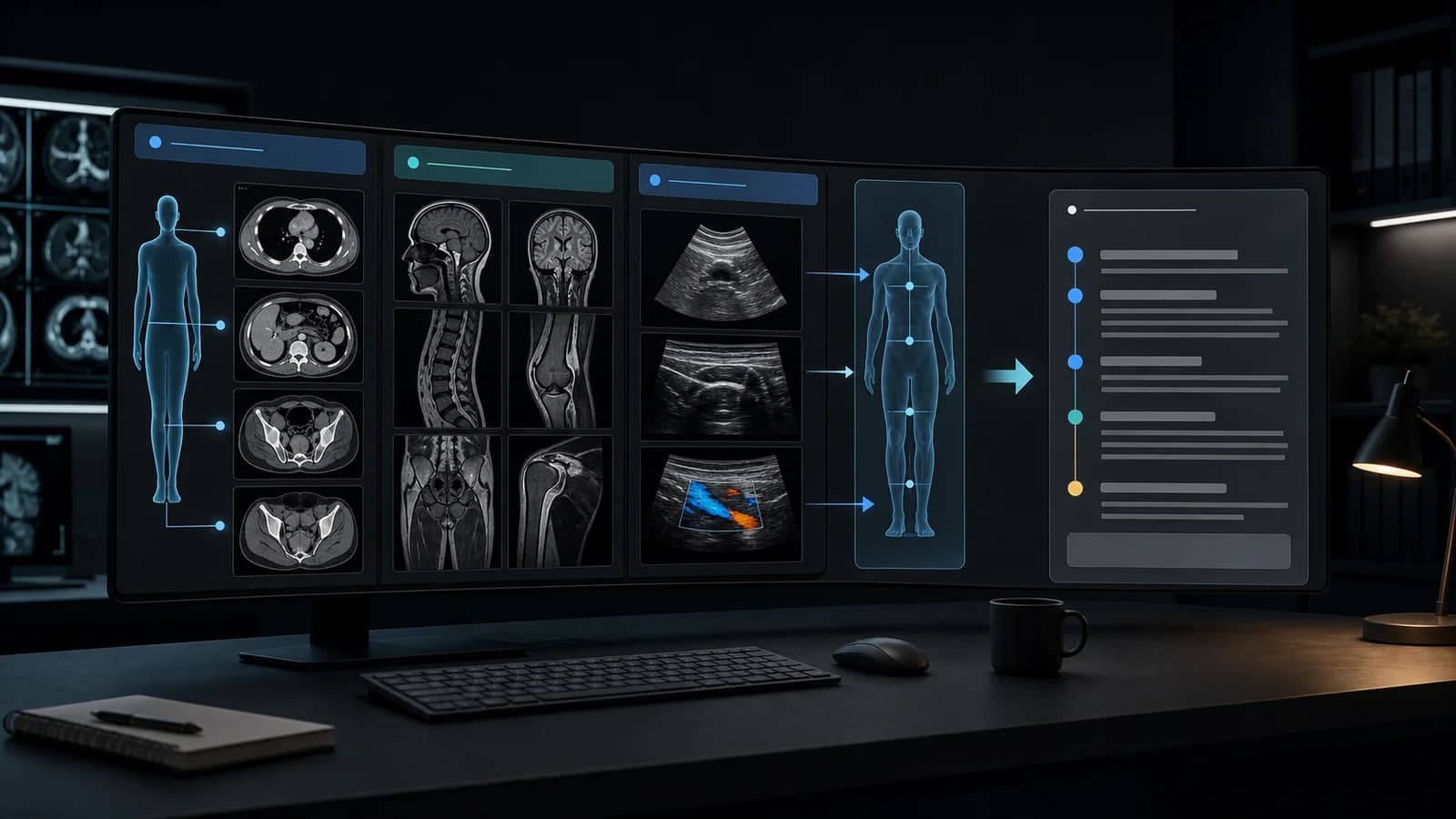
The scope of abdominal ultrasound depends on the order, clinical question, and local protocol. An upper abdominal examination usually targets the liver, biliary system, pancreas, spleen, and kidneys. A lower abdominal examination targets the bladder and, when appropriate, pelvic organs. A complete examination combines these areas but does not guarantee that every organ will be fully visible.
Fasting can improve gallbladder distention and upper abdominal assessment. A full bladder provides an acoustic window for pelvic organs. Preparation should not delay urgent imaging. Bowel gas, body habitus, pain, motion, and dressings can reduce image quality and must be reflected in the report.
Assessment framework
- Read the clinical question first and identify the target organ.
- Survey the liver, bile ducts, gallbladder, pancreas, spleen, and kidneys according to protocol.
- Record bladder filling and the approach used for pelvic assessment.
- Review the aorta and inferior vena cava where they are visible.
- State when the pancreatic tail or deep pelvis cannot be assessed.
What the report should contain
- Name the examination as upper, lower, or complete abdominal ultrasound in the technique section.
- Record fasting status and bladder filling when they affect interpretation.
- Address size, parenchyma, focal lesions, and duct caliber for each relevant organ.
- State where free fluid was sought and whether it was found.
- Make a limitation visible in the impression when it prevents an answer to the clinical question.
Common errors
- Treating a complete examination as an unlimited screening study.
- Calling a nonvisualized pancreas normal.
- Making a definitive pelvic assessment with inadequate bladder filling.
Example report wording
Example technique note: The patient was examined after six hours of fasting. The bladder is moderately full. The liver, gallbladder, bile ducts, spleen, and kidneys were adequately assessed. The pancreatic tail is partly obscured by bowel gas. A clinical concern directed at the pancreatic tail therefore cannot be excluded by this examination.
Use the complete abdominal ultrasound checklist for an organ-by-organ review order.
References
- ACR, AIUM, SPR and SRU. Practice Parameter for Ultrasound of the Abdomen and/or Retroperitoneum. Source (opens in a new tab)
- RadiologyInfo.org. Abdominal Ultrasound. Source (opens in a new tab)
Clinical note: This material is for radiology education. Do not generate an automatic diagnosis or management decision without checking guideline scope, patient factors, and local policy.
Clinical use note
This content is educational and is not patient-specific medical advice. Every phrase, template, classification result, and recommendation must be verified and adapted by a physician using the complete examination, clinical context, current guidelines, and institutional protocol.
Adapt the report framework to the case
Use this review order with an editable RadPhrases template and verify every line against the images.
Related calculators
Browse the other checklists, phrase sets, and systematic approaches in this topic.