
CAD-RADS 2.0: Coronary CTA Categories, Plaque Burden, and Modifiers
Apply CAD-RADS 2.0 to coronary CTA with stenosis categories, plaque burden, N/HRP/I/S/G/E modifiers, examples, and a reporting checklist.
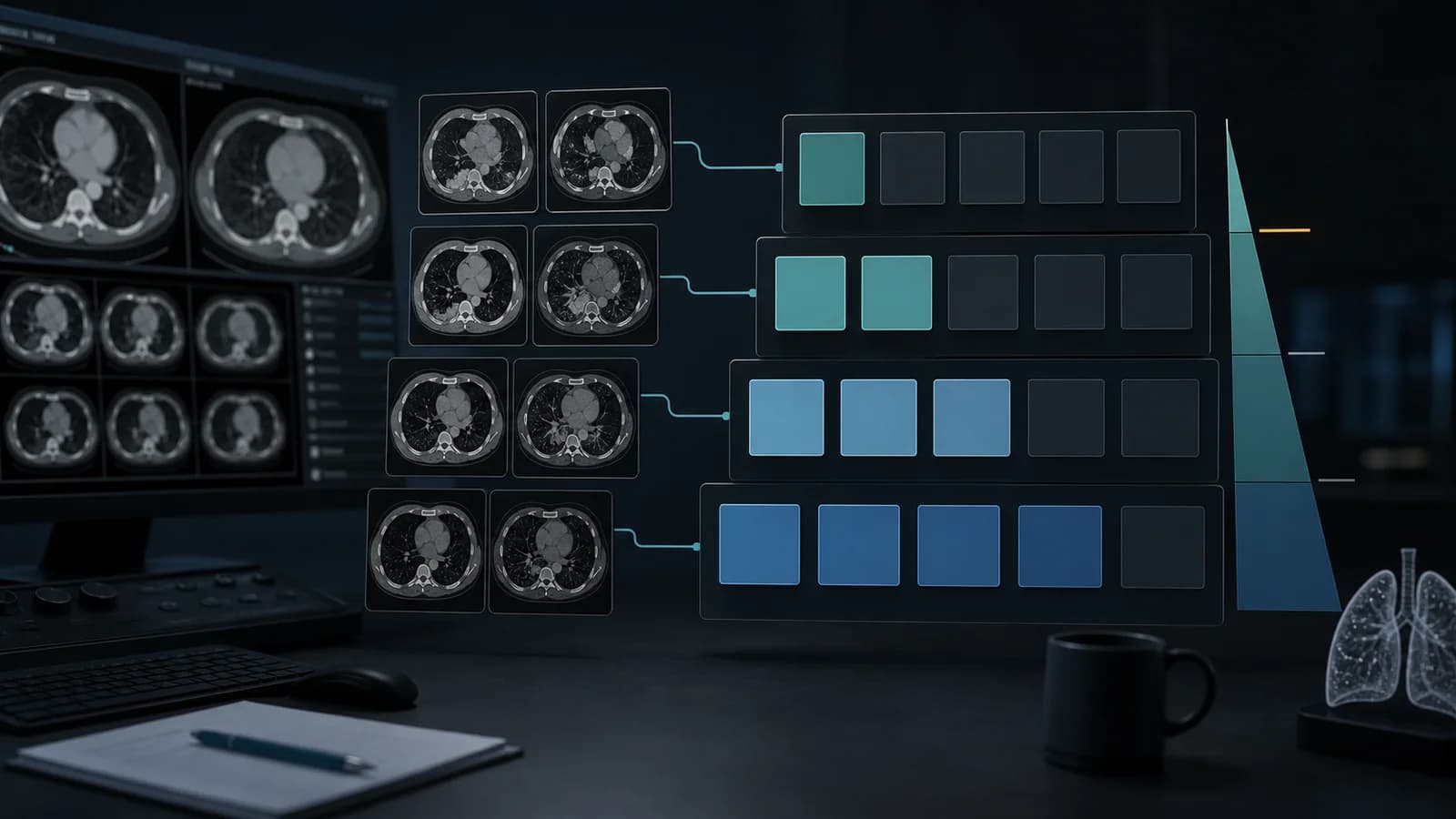
CAD-RADS 2.0 standardizes coronary CT angiography conclusions by combining the most severe coronary stenosis category, overall plaque burden, and clinically relevant modifiers. The final label summarizes the examination; it does not replace segment-by-segment findings or clinical management judgment.
Clinical scope Use CAD-RADS only in its intended coronary CTA context and follow the complete 2022 consensus document. Recommendations must be individualized to symptoms, indication, image quality, prior revascularization, and local practice.
Core stenosis categories
| Category | Most severe finding |
|---|---|
| CAD-RADS 0 | No plaque or stenosis |
| CAD-RADS 1 | 1–24% stenosis or plaque without stenosis |
| CAD-RADS 2 | 25–49% mild stenosis |
| CAD-RADS 3 | 50–69% moderate stenosis |
| CAD-RADS 4A | 70–99% stenosis in one or two vessels |
| CAD-RADS 4B | Left main at least 50% or three-vessel obstructive disease |
| CAD-RADS 5 | Total coronary occlusion |
| CAD-RADS N | Nondiagnostic study or segment that prevents reliable categorization |
Apply vessel-size eligibility and the complete consensus definitions. A severe stenosis in a tiny branch should not be handled as though it were equivalent to prognostically important epicardial disease.
Plaque burden is a second axis
CAD-RADS 2.0 adds plaque burden because total atherosclerotic load can alter preventive implications even when the maximum stenosis is mild. Report the supported plaque-burden descriptor using the method available in your practice, such as visual assessment or a validated quantitative approach. Do not infer a precise burden category from an incomplete examination.
Modifiers
Common modifiers include:
- N: nondiagnostic component
- HRP: high-risk plaque features
- I: ischemia assessment derived from CT, where applicable
- S: coronary stent
- G: bypass graft
- E: exceptions, including selected nonatherosclerotic coronary abnormalities
Modifiers are appended only when their definitions are met. The CAD-RADS 2.0 calculator can help assemble the label after you have completed the primary image interpretation.
Practical reporting sequence
- State image quality and any nondiagnostic segments.
- Describe coronary origin, dominance, and relevant anomalies.
- Report plaque and stenosis by vessel and segment.
- Identify the most severe eligible stenosis.
- Assign plaque burden independently.
- Add only applicable modifiers.
- Provide a concise conclusion and an individualized recommendation consistent with the full consensus and clinical context.
Example
A patient has 50–69% proximal LAD stenosis, nonobstructive plaque elsewhere, extensive overall plaque burden, and two validated high-risk plaque features. The summary may be expressed as CAD-RADS 3/P3/HRP, provided each element meets the consensus definition. The findings section should still identify the involved segments, morphology, and technical confidence.
Report-ready wording
Moderate proximal LAD stenosis (50–69%) with additional nonobstructive multivessel plaque. Overall plaque burden is severe by visual assessment. High-risk plaque features are present as detailed above. CAD-RADS 3/P3/HRP. Correlate with symptoms and current CAD-RADS 2.0 management guidance.
Frequent errors
- Assigning the category from plaque burden instead of maximum stenosis
- Omitting an N modifier when a critical segment is nondiagnostic
- Reporting HRP without the required feature definition
- Treating a stent or graft as a stenosis category rather than a modifier and separate finding
- Providing a CAD-RADS label without segment-level evidence
- Copying a generic management statement that conflicts with the clinical setting
Reference
Cury RC, et al. CAD-RADS 2.0—2022 Coronary Artery Disease-Reporting and Data System. Radiology: Cardiothoracic Imaging. 2022;4(5):e220183.
Clinical use note
This content is educational and is not patient-specific medical advice. Every phrase, template, classification result, and recommendation must be verified and adapted by a physician using the complete examination, clinical context, current guidelines, and institutional protocol.
Assemble the CAD-RADS 2.0 result
Select the highest stenosis category, plaque burden, and applicable modifiers, then verify the output against the full CCTA.
Related calculators
Apply the classification or measurement steps from this guide in an interactive tool.